Posts

Reverse Polish Notation - A Stack Application

Medium L.C. problem:  https://leetcode.com/problems/evaluate-reverse-polish-notation/ Evaluate the value of an arithmetic expression in  Reverse Polish Notation . Valid operators are  + ,  - ,  * ,  / . Each operand may be an integer or another expression. Note: Division between two integers should truncate toward zero. The given RPN expression is always valid. That means the expression would always evaluate to a result and there won't be any divide by zero operation. Example 1: Input: ["2", "1", "+", "3", "*"] Output: 9 Explanation: ((2 + 1) * 3) = 9 Example 2: Input: ["4", "13", "5", "/", "+"] Output: 6 Explanation: (4 + (13 / 5)) = 6 Example 3: Input: ["10", "6", "9", "3", "+", "-11", "*", "/", "*", "17", "+", "5", "+"] Outp...
Knight Dialer - A Classic Dynamic Programming Problem

Image
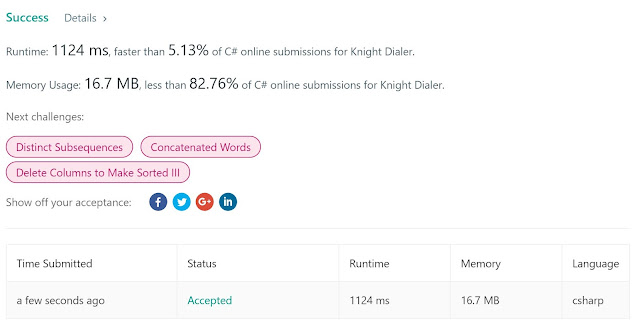
This was a very interesting problem, and a classic application of Dynamic Programming. Here is the problem: https://leetcode.com/problems/knight-dialer/ A chess knight can move as indicated in the chess diagram below: This time, we place our chess knight on any numbered key of a phone pad (indicated above), and the knight makes  N-1  hops.  Each hop must be from one key to another numbered key. Each time it lands on a key (including the initial placement of the knight), it presses the number of that key, pressing  N  digits total. How many distinct numbers can you dial in this manner? Since the answer may be large,  output the answer modulo  10^9 + 7 . Example 1: Input: 1 Output: 10 Example 2: Input: 2 Output: 20 Example 3: Input: 3 Output: 46 Note: 1 <= N <= 5000 The 10^9 + 7 to me is always the strongest indication that the solution should be done via DP. The also indication is that the N is ver...

Statistics from a Large Sample

Image
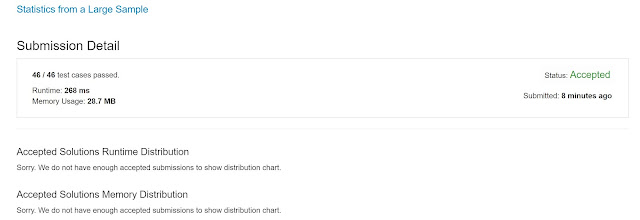
What I like about this problem is that it allows one to review some basic statistic concepts that will be needed for the rest of a professional mathematician or computer scientist career. Here it is:  https://leetcode.com/problems/statistics-from-a-large-sample/ We sampled integers between  0  and  255 , and stored the results in an array  count :   count[k]  is the number of integers we sampled equal to  k . Return the minimum, maximum, mean, median, and mode of the sample respectively, as an array of  floating point numbers .  The mode is guaranteed to be unique. (Recall that the median of a sample is: The middle element, if the elements of the sample were sorted and the number of elements is odd; The average of the middle two elements, if the elements of the sample were sorted and the number of elements is even.) Getting the min and max is very easy, so we'll skip explanation. Mean is easy too, all you have to do is a...

Permutation with no Repetition

Image
This is a classic problem with a well-established technique for solving it. Comes from Leetcode: https://leetcode.com/problems/letter-tile-possibilities/ You have a set of  tiles , where each tile has one letter  tiles[i]  printed on it.  Return the number of possible non-empty sequences of letters you can make. Example 1: Input: "AAB" Output: 8 Explanation: The possible sequences are "A", "B", "AA", "AB", "BA", "AAB", "ABA", "BAA". Example 2: Input: "AAABBC" Output: 188 Note: 1 <= tiles.length <= 7 tiles  consists of uppercase English letters. The solution (or better, one of the solutions) is as follows:  - Do a standard DFS using the "output position" to control the recursion  - Have a global hash table tracking the index  that has already been used  - Have a local  hash table tracking the character  that has already been used  - That...

Largest Prime Removing Digits From Left-Hand End

Image
Recently on Fermat's Library in Twitter , the following curiosity was posted: What if we tried the same but from the left-hand end? For example, "113" would be a candidate because: 113 is prime   13 is prime     3 is prime What's the largest of such a value? Is the a max one? Well let's leave the digit "zero" aside for now since we're looking to have unique numbers at each step of the sequence. There is actually a Max value for that! Here it is: 357686312646216567629137 Code to find it is down below - it uses BigInteger and Miller-Rabin for quick primality test. Also, DFS with pruning. Equally interesting as the twitter post. Cheers, ACC. using System; using System.Collections.Generic; using System.Linq; using System.Text; using System.Numerics; namespace FermatLibraryProblem { class Program { static void Main(string[] args) { BigInteger max = 0; Process(0, 1, ref max); ...

Remove All Adjacent Duplicates In String

Image
Here is the problem:  https://leetcode.com/problems/remove-all-adjacent-duplicates-in-string/ Given a string  S  of lowercase letters, a  duplicate removal  consists of choosing two adjacent and equal letters, and removing them. We repeatedly make duplicate removals on S until we no longer can. Return the final string after all such duplicate removals have been made.  It is guaranteed the answer is unique. Example 1: Input: "abbaca" Output: "ca" Explanation: For example, in "abbaca" we could remove "bb" since the letters are adjacent and equal, and this is the only possible move.  The result of this move is that the string is "aaca", of which only "aa" is possible, so the final string is "ca". Note: 1 <= S.length <= 20000 S  consists only of English lowercase letters. Given the S.length off the order of 20K, an N^2 solution would be intractable. Best is to think about this problem as ...

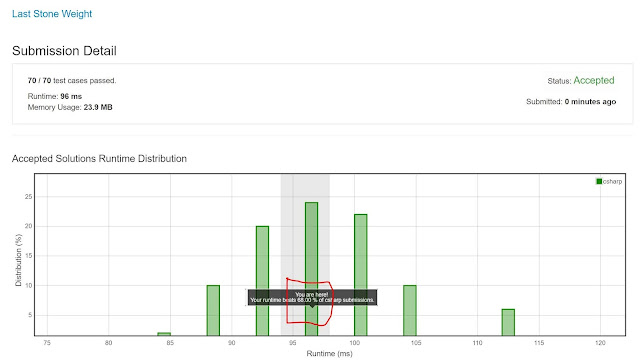
Last Stone Weight, an easy LeetCode problem

Image
Happy Sunday, folks! In this problem, there is a very simple data structure that can be used. Here is the problem:  https://leetcode.com/problems/last-stone-weight/ We have a collection of rocks, each rock has a positive integer weight. Each turn, we choose the two  heaviest  rocks and smash them together.  Suppose the stones have weights  x  and  y  with  x <= y .  The result of this smash is: If  x == y , both stones are totally destroyed; If  x != y , the stone of weight  x  is totally destroyed, and the stone of weight  y  has new weight  y-x . At the end, there is at most 1 stone left.  Return the weight of this stone (or 0 if there are no stones left.) Example 1: Input: [2,7,4,1,8,1] Output: 1 Explanation: We combine 7 and 8 to get 1 so the array converts to [2,4,1,1,1] then, we combine 2 and 4 to get 2 so the array converts to [2,1,1,1] then, we combine 2 and 1 to ...